
- Home
- About
- Map
- Trips
- Bringing Boat West
- Migration West
- Solo Motorcycle Ride
- Final Family XC Trip
- Colorado Rockies
- Graduates' XC Trip
- Yosemite & Nevada
- Colorado & Utah
- Best of Utah
- Southern Loop
- Pacific Northwest
- Northern Loop
- Los Angeles to NYC
- East Coast Trips
- Martha's Vineyard
- 1 Week in Quebec
- Southeast Coast
- NH Backpacking
- Martha's Vineyard
- Canadian Maritimes
- Ocracoke Island
- Edisto Island
- First Landing '02
- Hunting Island '02
- Stowe in Winter
- Hunting Island '01
- Lake Placid
- Chesapeake
- Provincetown
- Hunting Island '00
- Acadia in Winter
- Boston Suburbs
- Niagara Falls
- First Landing '99
- Cape Hatteras
- West Coast Trips
- Burning Man
- Utah Off-Roading
- Maui
- Mojave 4WD Course
- Colorado River Rafting
- Bishop & Death Valley
- Kauai
- Yosemite Fall
- Utah Off-Road
- Lost Coast
- Yosemite Valley
- Arizona and New Mexico
- Pescadero & Capitola
- Bishop & Death Valley
- San Diego, Anza Borrego, Joshua Tree
- Carmel
- Death Valley in Fall
- Yosemite in the Fall
- Pacific Northwest
- Utah Off-Roading
- Southern CA Deserts
- Yosemite & Covid
- Lake Powell Covid
- Eastern Sierra & Covid
- Bishop & Death Valley
- Central & SE Oregon
- Mojave Road
- Eastern Sierra
- Trinity Alps
- Tuolumne Meadows
- Lake Powell Boating
- Eastern Sierra
- Yosemite Winter
- Hawaii
- 4WD Eastern Sierra
- 4WD Death Valley +
- Southern CA Deserts
- Christmas in Tahoe
- Yosemite & Pinnacles
- Totality
- Yosemite & Sierra
- Yosemite Christmas
- Yosemite, San Diego
- Yosemite & North CA
- Seattle to Sierra
- Southwest Deserts
- Yosemite & Sierra
- Pacific Northwest
- Yosemite & South CA
- Pacific Northwest
- Northern California
- Southern Alaska
- Vancouver Island
- International Trips
- Index
- Tips
- Books
- Photos/Videos
- Search
- Contact
Petrified Forest National Park
Saturday, August 10, 2002 - 10:00am by Lolo115 miles and 2.25 hours from our last stop
Travelogue
Petrified Forest National Park was one of those stops that I'm embarrassed to say we visited, because we hardly saw any of it. At this point in our journey, we were on our way home and didn't have the ½ day needed to really do the park justice. However, knowing that the Painted Desert Visitor Center was less than a mile off I40, we just couldn't resist pulling off for a quick look see.
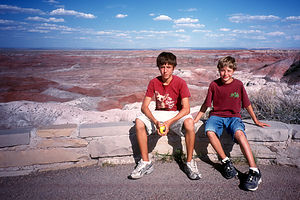 Cranky offspring suffering trip fatigueThe park is actually divided into 2 sections, and we were in the much smaller part, north of I40. This was the section that contained the spectacular colorful badlands of the Painted Desert. South of I40 was the major part of the park, a 25-mile drive through an area containing one of the world's largest concentrations of petrified wood.
I hate to admit it, but all we did was stop at the Visitor Center and then drive to Kachina Point Lookout where we gazed blankly at the breathtaking beauty of the colorful badlands of the Painted Desert. If this had been our first experience with the beauty that the West had to offer, we would have been floored. Unfortunately, it was late in the day and we were at the end of a multi-week trip where we had seen so many beautiful places that we were suffering from sensory overload and trip fatigue. It was hard to get the kids worked up about another incredible sight when they had already seen so many in our 3 weeks of travel. This would have been a totally different experience if it had been at the beginning of our trip. I made one feeble attempt to get the family to hike the Rim Trail to Tawa Point (I hate to go down without a fight), but they refused.
This is definitely a place that I want to come back to when we are more fresh and enthusiastic as there are an awful lot of things to see and do here. I can't believe that my only sighting of petrified wood was in a gift shop.
Description
Petrified Forest National Park, which is located along I40 in eastern Arizona, consists of two main sections. The section south of I40 contains one of the world's largest concentrations of petrified wood. North of I40 are the colorful rocks and buttes that make up the badlands of the Painted Desert.
The best way to see the park is to drive the 27-mile park road from the southern entrance to the north. A good first stop is the Rainbow Forest Museum. Behind the museum is the ½-mile, self-guided Giant Logs Trail, which leads through one of the four major concentrations of petrified logs in the park. The largest petrified log is Old Faithful, which is 9 ½ feet in diameter.
A short spur road leads to Long Logs and the Agate House. At Long Logs there is a ½-mile loop trail that leads through the largest concentration of petrified wood in the park. Some of the logs are as long as 170 feet. The 1-mile-long Agate House Trail leads to an Anasazi pueblo made of petrified wood.
Continuing north on the park road, you'll come to the Crystal Forest where the petrified logs were once filled with quartz and amethyst crystals. Although gem hunters have taken most of the crystals before this area was a National Park, there are still some very colorful logs to see along the 0.8-mile loop trail.
Further north, a 3-mile spur road leads to Blue Mesa, with its blue and purple-striped badlands. A fairly difficult, 1-mile loop trail descends into the mesa. Many consider this to be one of the most scenic trails in the park.
The next stop is the Puerco Indian Ruin, the remains of an Anasazi village occupied in the 1100 - 1300s. There are also petroglyphs carved out of the patina of the rocks surrounding the pueblo.
The park road then crosses I40 and enters the Painted Desert portion of the park. Along the road to the Visitor Center there are 8 overlooks, each affording a different perspective of this colorful landscape. One of the most spectacular is Pintado Point, the highest point along the rim of the Painted Desert. At Kachina Point is the Painted Desert Inn, now closed, and the trailheads for the Painted Desert Wilderness Trail and the Painted Desert Rim Trail. The Wilderness Trail steeply descends in switchbacks down the face of the badlands onto the floor of the Painted Desert. With a backcountry permit, you can camp here and watch the sun set over the badlands. The Rim Trail runs along the rim of the Painted Desert from Kachina to Tawa Point. Along the way there are spectacular views of the colorful badlands of the Painted Desert.
Walnut Canyon National Monument
Saturday, August 10, 2002 - 7:00am by Lolo90 miles and 1.75 hours from our last stop
Travelogue
As we got onto I40 eastbound, we were officially on our way back home, which for some reason set a different tone--less frantic and more mellow. The anticipation of the unknown was behind us and there was a feeling of satisfaction from having shared some wonderful experiences together. Anything from this point on was just icing on the cake.
 Boys in cliff dwellingThere is an awful lot to see along the section of I40 that goes through Arizona and New Mexico, so there were plenty of choices for breaking up our long drive home. Our first stop was at Walnut Canyon National Monument in central Arizona where there are ancient cliff dwellings built into the sides of a 400-foot-deep canyon. These were the ancestral homes of the Sinagua people, the ancestors of the modern-day Pueblo. They lived in these cliff dwellings from about 1100 to 1250. Today it is considered a sacred place by the Pueblos.
Wanting to do more than just observe the dwellings from the rim of the canyon, we took the fairly strenuous Island Trail, which took us 185 feet down into the canyon. Along the trail, we were actually able to enter some of the cliff dwelling rooms. It was a very different experience from the more crowded, ranger-led tours of the Mesa Verde cliff dwellings. Although less dramatic and on a much smaller scale than Mesa Verde, it was interesting to experience the dwellings on our own with almost no one else around.
Description
Walnut Canyon, located in central Arizona right off I40, is the most easily accessible of the numerous prehistoric settlements in the Southwest. Within the 400-foot-deep canyon are cliff dwellings built into the sides of the canyon walls by the ancient Sinagua people around 1100 to 1250 AD.
 Spouses resting on Island TrailThe best way to see the ruins is to hike the Island Trail, a 1-mile loop that takes you 185 feet down into the canyon providing access to 25 cliff dwelling rooms. Climbing down and up the 240 steps into and out of the canyon is fairly strenuous.
A less strenuous hike is the 3/4 mile Rim Trail which takes you to viewpoints down into the canyon.
Sedona - Bell Rock
Saturday, August 10, 2002 - 3:00am by Lolo20 miles and 0.5 hours from our last stop
Travelogue
 New Age FamilyWe couldn't leave the area without experiencing the "new ageness" of Sedona so we chose a mountain bike expedition around Bell Rock, which is claimed to be one of the most powerful of the 13 vortexes in the Sedona area. These vortex spots theoretically enhance your psychic powers, emotions, and talents and leave you feeling energized and in tune with your inner being. Hey, that's what vacations are supposed to do aren't they? The ride was great and we did feel energized and at peace, but I'm not sure that it wasn't just from being outdoors and doing something that we love to do.
The trailhead for the Bell Rock ride is on U.S. 179 about 10 miles south of Sedona in the village of Oak Creek. There is ample parking at the trailhead. The trail itself is nice and wide and has amazing views of the surrounding red rock, including Courthouse Butte and Bell Rock. The trip can be anywhere from 3 to 10 miles round trip depending on what side trips you take. The kids really enjoyed this ride and there wasn't any whining. Maybe there really is a vortex here.
Description
Bell Rock, in the heart of Arizona's red rock country, is a rock formation shaped, as its name would imply, like a bell. The trailhead, which has plenty of parking, is located on U.S. 179 about 10 miles south of Sedona in the village of Oak Creek.
Bell Rock is claimed to be one of the most powerful of the 13 vortexes in the Sedona area. According to "New Agers," these vortex spots contain special energy forces that are felt by many that visit them. Each of the different vortexes in the Sedona area theoretically has different powers: Bell Rock (active masculine power), the Airport (gentle masculine energy), Cathedral Rock (nurturing feminine energy), Boynton Canyon (has both masculine and feminine energy) and Chapel (a gentle, comforting feminine touch).
From the Bell Rock Trailhead, there is a great family mountain biking trail which takes you past Courthouse Butte and Bell Rock, with amazing views of the red rock along the way. The trip can be anywhere from 3 to 10 miles round trip depending on what side trips you take.
Keep in mind this is desert and quite hot in the summer, so take plenty of water along with you.
Slide Rock State Park
Friday, August 9, 2002 - 11:00am by Lolo40 miles and 1 hour from our last stop - 1 night stay
Travelogue
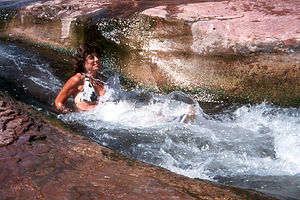 Lolo sliding the slide rock gorgeWater activities of any sort are always a favorite of ours so we tend to seek them out. After the heat and barrenness of Sunset Crater Volcano National Park, we were ready for a refreshing swim. We started down the beautiful Oak Creek Canyon Drive which runs from Flagstaff to Sedona. The 27-mile drive is breathtaking as it meanders through ponderosa pine forests in the north to the dramatic red rock of Sedona in the south. At many points along the way, there is access to the chilly but refreshing waters of Oak Creek.
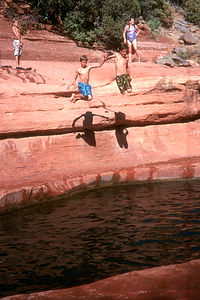 Boys jumping in Slide Rock State ParkBefore settling down to some fun, we usually like to establish where we are going to stay for the night. As we drove along Oak Creek Canyon Drive, we were getting discouraged by the "Campground Full" signs outside each of the National Forest areas. We finally decided to drive into one anyway to ask for advice on where to stay. Luckily for us, someone was checking out early as we were pulling in so we were able to get a campsite for the night. This isn't the first time this has happened to us. The campground was very pretty, with a portion of Oak Creek running through it and lots of ponderosa pines to shade you from the heat.
We then headed a few miles down the road to Slide Rock State Park where there was a line of cars waiting to pay the $8 admission fee. As we had been warned, the parking lot was quite full and the park was fairly crowded. Even so, there was plenty of red rock to sit on and no wait to use the natural slide. The slide was great fun. The water was very chilly, but the air was so warm and dry that it was very welcome. The algae-covered sandstone scrapes you up a bit so long shorts or even jeans would have been a better idea than a bikini. We spent a good part of the afternoon sliding down the rocks, jumping off into the pools of water, and sunning ourselves on the warm slabs of red rock.
Description
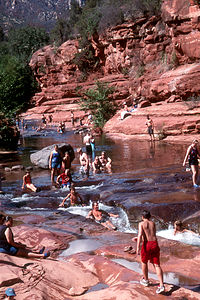 Herb slides too!Slide Rock State Park, located about halfway along the Oak Creek Canyon Drive, is one of Arizona's most popular natural playgrounds. The park contains a 70-foot natural water slide that flows over algae-covered sandstone. Although the water is chilly and the ride is rough, it is a tremendously fun way to spend a hot afternoon. There is a small admission fee to enter.
Sunset Crater Volcano National Monument
Friday, August 9, 2002 - 3:00am by Lolo80 miles and 1.75 hours from our last stop
Travelogue
 Family Hiking Lava Flow Nature TrailOur drive down Route 89 towards Sedona brought us right past Sunset Crater Volcano National Monument. Having never been disappointed by the places the National Park System has set aside for our enjoyment, we decided to stop and check it out.
At the Visitor Center we learned to our surprise that northern Arizona has more than 400 volcanoes, and this one is the youngest of them all, having erupted as recently as 1250. Sunset Crater is actually a volcanic cone composed of lava fragments called cinders. Around 1,000 years ago, a series of eruptions spewed debris which built up into the 1,000 foot cone you see today. The lava in the final eruption in 1250 contained oxidized iron, which covered the summit with brilliant red cinders. Since the redness of the summit looks like a permanent sunset, the volcano was named Sunset Crater.
We would have loved to hike out on the cinder cone itself, but unfortunately that has been prohibited since 1973. Instead, we had to satisfy ourselves with the 1-mile, self-guided Lava Flow Nature Trail which goes along the base of the volcano. It was pretty interesting though, and we did get a chance to see the lava flow up close.
Description
Sunset Crater Volcano National Monument is located on US 89, about 16 miles north of Flagstaff.
Sunset Crater Volcano, the youngest of more than 400 volcanoes in north-central Arizona, is a volcanic cone composed of lava fragment called cinders. It was formed in a relatively recent eruption in 1064, when a mixture of molten rock and compressed air spewed into the air, solidified, and then fell back to the earth as cinders and ash. Additional eruptions over the next 200 years built up more and more debris around the vent, resulting in the 1,000 foot cone you see today. The final eruption of Sunset Crater, which occurred around 1250, spewed out lava containing oxidized iron, causing the summit to be covered with brilliant red cinders, like a permanent "sunset."
Hiking on the cinder cone itself has been prohibited since 1973. However, the 1-mile, self-guided Lava Flow Nature Trail along the base of the volcano provides close-up views of the lava flow.
Grand Canyon - South Rim
Thursday, August 8, 2002 - 8:30am by Lolo80 miles and 1.75 hours from our last stop - 1 night stay
Travelogue
Stopping at the South Rim of the Grand Canyon was a very spontaneous decision on our part--not our usual style, but as we drove along Highway 89 on our way to Sedona and saw the turnoff for the East Entrance to the Park, we just couldn't resist. I mean, how can you just drive past the Grand Canyon without stopping for a peek? Even though we had been to the Grand Canyon twice before, it had been to the much less visited North Rim, so the South Rim would really be something new for us.
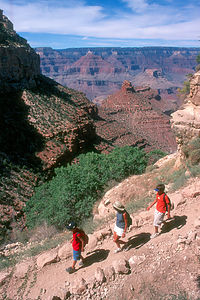 Lolo and the Boys Hiking Bright Angel TrailWe figured there was no way we were going to find a campsite in the park, but worst case, we could just visit for awhile and then continue on our way to Sedona. So, we hung a right into the park and drove west along the rim of the canyon on the very scenic 26-mile long Desert View Drive, pulling over frequently to enjoy the incredible views.
When we reached Grand Canyon Village, we pulled into Trailer Village Campground, feeling quite certain that we would be turned away. To our surprise, they had one site available for one night--perfect! We couldn't believe our luck. Since the Village is really too crowded to drive an RV around, we parked it in our campsite and took a shuttle from the campground to the main part of the village.
We knew exactly what we wanted to do--hike the Bright Angel Trail, or at least part of it, down into the Canyon. This is the most popular hike in the park and it's certainly easy to see why. We began our hike at the Rim, and began descending a series of steep switchbacks that seemed to go on forever. The views along the way were breathtaking. The entire 7.7-mile hike down to the Colorado River, 4,420 feet below, takes about 4 hours to get down and another 8 hours to hike back out--not exactly a day trip. Our much more modest goal was to hike down to the One-and-a-Half Mile House, which as you might guess is 1.5 miles down and then 1.5 miles up again. Three miles might sound easy, but with the extreme heat and the steepness, it definitely wasn't.
When we reached the One-and-a-Half Mile House, we saw a ranger aiding a hiker suffering from heatstroke or dehydration--a reminder to us that hiking in the Grand Canyon is not to be taken lightly. The summertime temperatures on the canyon floor often exceed 100 degrees, so plenty of water must be carried and hiking must be done early in the day or late in the afternoon.
Once back out of the canyon, we hiked along the Rim Trail, which runs 9.2 miles along the canyon's edge past most of the attractions in Grand Canyon Village. This trail makes the canyon views very accessible for those unable to make the steep climbs required to actually enter the canyon. We stopped briefly in the historic El Tovar Hotel, the famous hotel located just 20 feet from the canyon's rim. The National Park Service really does a wonderful job at creating structures that add to rather than detract from the natural beauty around them.
Tired and satisfied with our day's hike, we took the shuttle back to the campground. I think we were all glad that we took the detour and got a chance to see the South Rim; however, I must say, I prefer the more secluded and less developed North Rim.
Description
Grand Canyon National Park, which is located in northern Arizona, is the nation's most popular national park, with over 5 million visitors a year. Everything about it is massive--it is 277 miles long, 1 mile deep, and an average of 10 miles across. The views from the rim are unparalleled and extend for as much as 200 miles on a clear day.
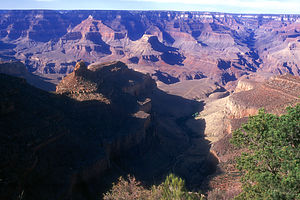 It's a Grand CanyonThe Grand Canyon is one of the most spectacular examples of erosion anywhere in the world, displaying 2 billion years of geological history on its canyon walls. For millions of years the waters of the Colorado River have carved this canyon, while runoff from the rim has cut hundreds of side canyons separated by buttes and mesas rising a thousand feet from the canyon floor. Its beauty defies description and a visit to the canyon is a humbling experience.
There are two ways to visit the park--the South and the North Rim. Although they are only 10 air miles apart from each other, it is a 215-mile drive between them. The South Rim, which is open all year, is by far the more popular section with more than 10 times the number of visitors than the North Rim, which is only open from May to late October. Advanced reservations are definitely recommended.
There are some wonderful day and overnight hikes in the park. However, because of the high demand for overnight permits, you should send in your application as early as 4 months in advance. Also, remember that summertime temperatures on the canyon floor often exceed 100 degrees, so pack plenty of water and hike in the early part of the day.
South Rim - Elevation 7000 feet
Because the South Rim is so crowded, it is switching over to a mass transit system in the next few years. A great way to approach the South Rim is from the east on the 26-mile long Desert View Drive which has numerous pull-offs to stop and enjoy the vistas.
Once you're there, a good way to see the sights is to hike the Rim Trail which runs 9 miles along the canyon's edge from Hermits Rest to Mather's Point, passing most of the attractions in Grand Canyon Village along the way.
The most popular hike of all in the park is the Bright Angel Trail which takes you zigzagging on switchbacks 7.7 miles and 4,420 feet down to the Colorado River. The views along the way are breathtaking. It takes about 4 hours to hike down and twice that to hike back, so it is not recommended as a day hike. A shortened version down to One-and-a-Half-Mile House, Three-Mile House, Indian Garden, or Plateau Point and back would be a more appropriate day hike choice.
Monument Valley
Wednesday, August 7, 2002 - 10:00am by Lolo112 miles and 2 hours from our last stop - 1 night stay
Travelogue
Since mountain biking is probably my favorite way of truly experiencing a place, I was anxiously anticipating our visit to Monument Valley. While reading Mountain Biking Utah, I discovered that the scenic loop through Monument Valley was actually listed as a relatively easy to moderate bike ride. This was great because I had already learned that RVs were not permitted on the loop.
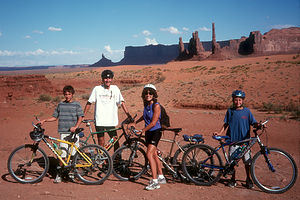 Family crazy enough to bike Monument ValleyWe checked into Goulding's Monument Valley RV Park and got a great campsite overlooking the red sandstone buttes of Monument Valley. Fortunately for us, the day was a cool 84 degrees, not bad for desert in midsummer. It seemed like the perfect day for a bike ride. In my excitement to get started, I happened to mention our planned bike ride to the campground manager. He looked blankly at me and said, "You're going to bike ride the loop?" Undaunted, we set off in the RV to drive the mile into the Monument Valley Tribal Park.
While paying our entrance fee, we mentioned to the Native American at the entrance gate that we were planning to mountain bike the loop. I should have been concerned when he said he'd never heard of anyone doing that before. He must be new, I thought. The mention of my plan to a woman behind the desk in the Visitor Center brought the same blank stare of confusion. I, however, am a firm believer in the truth of the written word and I had clearly read about this ride in a Mountain Biking Utah guide.
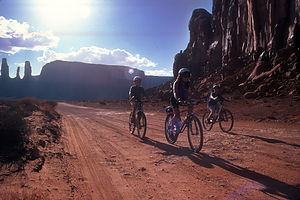 Biking Monument ValleyWe parked our RV in the lot, unloaded our bikes, and set off on our adventure. The ride started with a sharp 500 foot descent down the sandy washboard road. Although going down was fun, I can't enjoy a downhill with complete abandon when I know that at a later point in the day it will be a tortuous uphill climb. Oh well, I decided not to think about that for now and to just coast on, enjoying the fabulous views.
Ever since our boys were little, we always tried to encourage them to push themselves and go the extra mile so to speak. On bike rides, I would use the promise of something good just around the corner to keep them going. In the past, that has meant just another mile for ice cream or we're almost at the beach, etc. With no amusement parks or ice cream shops in sight, I had to try to tempt them with the roadside sale of Navajo trinkets and the promise that I think we're halfway around the loop by now so turning back isn't going to make it any shorter.
All the while we were pedaling, a constant flow of cars went by, kicking up clouds of the dry red sand. We must have been quite a spectacle because people were waving and cheering us on. I tried to let their cheering drown out the whining which was now coming from my younger son.
Meanwhile, my husband who wants to document these adventures as later proof of our wonderful parenting, is pedalling ahead of us, jumping off his bike, removing his movie camera from his backpack, and filming us riding towards him. He repeated this process about a dozen times throughout our ride. He must have been exhausted.
By the time we finished the ride, we were covered in a thin coat of red sand and probably could have passed for Navajos. No matter what anyone says, I think it was a great ride and the only way I would have wanted to see it. Anyone can drive the loop, but I feel we truly earned it.
Description
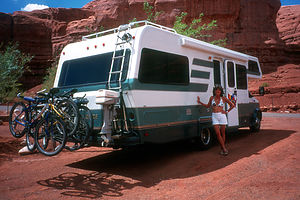 Lolo of the RV at GouldingsMonument Valley is a Navajo Tribal Park that is famous for its red sandstone towers and buttes. The park has a Visitor Center and a 17-mile scenic drive. The self-guided drive begins at the Visitor Center and loops through the valley on a dirt road with many breathtaking overlooks. The road is definitely not meant for RVs. Jeep tours are also available, but quite expensive. There is a campground in the park, as well as one 2 miles away at Goulding Trading Post.
Four Corners
Wednesday, August 7, 2002 - 8:45am by Lolo32 miles and 0.75 hours from our last stop
Travelogue
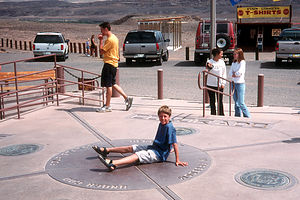 Tommy at 4 CornersWe just had to do it. I don't know why. It had no natural beauty; it wasn't any sort of manmade wonder; it wasn't even free. But something compelled us to pay our $10 so we could simultaneously place our left foot in Arizona, our right foot in New Mexico, our left hand in Utah, and our right hand in Colorado, thereby being in 4 states at the same time. It was like playing Twister.
The site where the 4 states meet was marked by an attractive granite and brass marker. We watched as people formed lines at each of the 4 sides of the marker. We lined up in Arizona. Then alternating turns, like at a 4-way stop sign, someone would step up to the marker, do their own creative approach to spanning the 4 states, and then move on. It was quite civilized.
Description
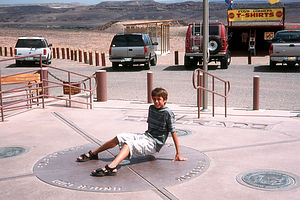 Andrew at 4 CornersFour Corners is the only place in the United States where four states intersect at one point: Arizona, New Mexico, Utah, and Colorado. At the granite and brass marker marking the border of the four states, you can place your feet and hands so that you are in all four states at the same time.
Both the Navajo and Ute people, who live in the area, set up booths in the summer selling handmade jewelry and crafts and traditional Navajo foods.
The Four Corners Monument is administered by the Navajo Nation Parks and Recreation Department. An entrance fee of $2.50 is charged.
Ship Rock
Wednesday, August 7, 2002 - 6:00am by Lolo158 miles and 3.25 hours from our last stop
Travelogue
As we continued west across northern New Mexico on Route 64, we kept scanning the horizon hoping to catch a glimpse of Shiprock, the incredible 1,700 rock formation shaped like a Clipper ship. Herb spotted it first, from probably over 20 miles away, rising abruptly from the desert floor, the only thing breaking up the otherwise flat landscape. It really did look like a ship, complete with masts and sails.
 Ship RockI had done my research and knew that our closest view of it would be from alongside U.S. 666, about 6 or 7 miles south of the town of Shiprock. Getting any closer to it was not an easy option since the Navajo people view this rock as sacred and keep it off limits for fear of white men stirring up the souls of their dead ancestors.
So, we pulled over to the side of 666 to take some photos. Unfortunately, the fences and telephone lines made it difficult to get an unobstructed view, but we did our best. In his excitement to be the first to photograph the monolith, Tommy ran out of the RV barefoot onto the grass alongside the road, oblivious to the fact that the grass was full of burrs. Thank goodness for the surgical tweezers Herb carries in his first aid kit. It probably took him close to an hour to remove the tiny, yet quite painful, burrs. I think the souls of the ancient Navajo were making sure we didn't come any closer.
Description
Shiprock is a spectacular rock formation in northwestern New Mexico that rises 1,700 feet above a 5,500-foot-high plain. Early explorers named it "Shiprock" because of its resemblance to a 19th century Clipper ship. It can be seen from as far as 100 miles away.
The best places to view Shiprock are along U.S. 666, 6 or 7 miles south of the town of Shiprock. You can get closer by taking the tribal road to the community of Red Rock. Permission to go any closer must be obtained from the Navajo people, who view this rock as sacred and off limits to climbers.
The Navajo call the rock Tse'Bit'Ai, or "rock with wings." According to their legend, the Gods saved them from their enemies by causing the ground to rise, lifting them like a great wave away from their enemies to where Shiprock Peak now stands. The Navajos lived on the top of this new mountain, only coming down to plant their fields and to get water. One day while the men were working down in the fields, a storm came and lightning struck the rock, splitting off the trail and leaving only a sheer cliff. The women, children, and old people were stranded on the top and eventually starved to death. Because of this legend, the Navajos do not want any one to climb Shiprock Peak for fear of stirring up the souls of the dead.
Heron Lake State Park
Monday, August 5, 2002 - 8:30am by Lolo120 miles and 3 hours from our last stop - 2 night stay
Travelogue
 Rafting across Heron LakeTo this day, Herb's eyes glaze over with a dreamy look at the mere mention of Heron Lake. First, there was its natural beauty--picture a gorgeous mountain lake set among tall pine trees. Then there was the incredible cocktail opportunities--sunset views over the lake right from our campsite. Lastly, and probably most importantly, was the solitude and tranquility--we shared the entire lake with only one other camper, and he was always out on his sailboat. Heron Lake is not for those that need a lot of excitement and activities (which is probably why it wasn't crowded), but for us, at this point in time, it was paradise. My only problem was going to be convincing Herb to ever leave.
The lake had a no-wake regulation (which probably accounted for its tranquility), making it a perfect place for us to use our Avon inflatable boat with its 6 h.p. motor. We launched the boat right from our campsite, which was set back from the lake about 100 yards. Our campsite should have been right on the lake, but a multi-year drought had made the lake levels terribly low. This, unfortunately, made the approach to the lake quite difficult because the new shoreline was solid muck. We managed to get the boat in without too much mess and putted over to the island in the middle of the lake.
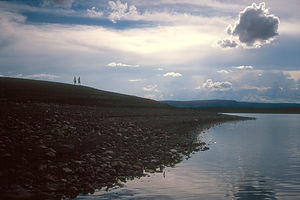 Boys on uninhabited islandIt was great just being out on the lake--big vistas, crystal blue New Mexico sky, and just one sailboat in sight (our neighbor). We did swim, although the lake waters were cool. After all, we were over 7,000 feet above sea level.
That night we barbecued while the kids gathered twigs and branches for a campfire. After watching a perfect sunset over the lake, we ate our dinner by the fire which the kids had built. It was just so unbelievably peaceful here--a pleasant respite from our normally hectic lives.
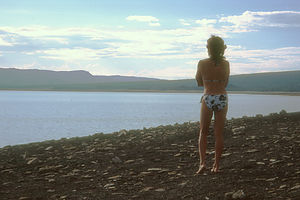 Lolo of Heron LakeThat night we were awakened by the most incredible thunderstorm I have ever experienced in my life. After one particularly loud crash of thunder, Herb and I bolted upright and looked out the back window behind our bed, which happened to look out over the lake. We were mesmerized. Across the entire sky, there were simultaneous bursts of lightning, more impressive than any fireworks display I have seen. We woke the boys up, and they jumped in bed with us to watch the show. I wish we had thought to film the storm because it's too difficult to describe. Maybe this is what thunderstorms are like out here because of the panoramic vistas, but we New Jerseyians were certainly impressed.
The next morning we rode our bikes about 2 miles down the hill to the Heron Dam--I was not looking forward to the 2 mile uphill climb later. Near the dam, we turned off on a road with signs for the Rio Chama Trail and eventually came to a rock staircase that led down to the river. Leaving our bikes behind, we went down the stairs and walked across a suspension bridge over the river. This was the beginning of the 5 ½ mile Rio Chama Trail that followed the river connecting Heron and El Vado Lake. Probably a great hike, but not on our program for today. We returned to our bikes and road up the steep hill to the campground.
We reluctantly said goodbye to Heron Lake and headed west towards Monument Valley.
Description
Heron Lake is a 5,900-acre reservoir in northern New Mexico's forested mountain country (elevation 7,200 feet). The state has designated it a "quiet lake" requiring boaters to operate at no-wake speeds. Nearby El Vado Lake has no restrictions on boating speed limits, thereby attracting many more power boaters and jet skiers. As a result, Heron Lake is a very peaceful and tranquil place.
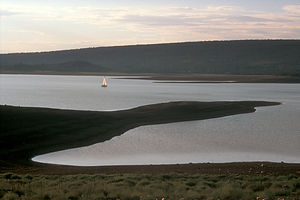 Lone neighbor sailing at dusk on Heron LakeThe no-wake regulation, combined with the lake's steady breezes, make it a premier spot for sailing and windsurfing. Swimming and fishing for salmon and trout (especially below the dam) are also popular activities in the park.
A 5.5 mile fishing and hiking trail along the Rio Chama River connects Heron and El Vado Lakes. The trail starts at a caprock stairway near the Heron Dam, crosses the river on a suspension bridge, and meanders along the river canyon to El Vado Lake.
The park has 139 RV sites along its eastern shores, some of them with hookups.
